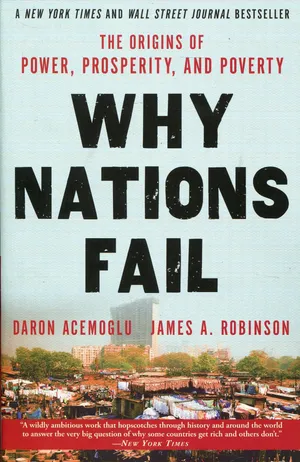
I have to say that I'm not a person that enjoys reading history a lot, with some exceptions like biographies or certain authors that make it interesting. When I bought this book I thought that it would be something different and that's not a bad thing.
Let's understand a bit about it.
Book premise
I want to keep things spoiler-free, at least as much as I can since this is not entirely a novel, but I liked the book's description a lot.
Why are some nations more prosperous than others? Why Nations Fail sets out to answer this question, with a compelling and elegantly argued new theory: that it is not down to climate, geography or culture, but because of institutions. Drawing on an extraordinary range of contemporary and historical examples, from ancient Rome through the Tudors to modern-day China, leading academics Daron Acemoglu and James A. Robinson show that to invest and prosper, people need to know that if they work hard, they can make money and actually keep it - and this means sound institutions that allow virtuous circles of innovation, expansion and peace.
"Drawing on an extraordinary range of contemporary and historical examples" is an understatement. The book is filled with history and leans heavily on the assumption that you know history (like me that's why it's perfect), so that you learn what happened and then why it contributed to the decline of a country, empire or everything in between.
The author(s)
You can say that both authors have a lot of experience
Based on fifteen years of research, and answering the competing arguments of authors ranging from Max Weber to Jeffrey Sachs and Jared Diamond, Acemoglu and Robinson step boldly into the territory of Francis Fukuyama and Ian Morris. They blend economics, politics, history and current affairs to provide a new, powerful and persuasive way of understanding wealth and poverty.
You can tell that they have a lot of experience but I want to focus on the "blend economics, politics and history" that's the most interesting part of the book. It merges all these in very interesting ways and it shows, always based on examples, where things failed.
But it's not only experience that they have. They also have a Nobel Memorial Prize in Economic Sciences and that's not something to ignore.
Why did I like it?
Like I mentioned above it's hard for me to read about history, but while reading this book I started to think a lot about what people and countries did to gain influence and what contributed to their decline. Without naming names, and I'm sure you'll see this when you read it, you would start doing parallels to today's society and challenges and understand that history indeed repeats itself.
Wonderful read if you have the energy and attention span for a lot of necessary exposition to understand why nations fail.
You can also read Bill Gates's review of the book but I have to warn you that it's not entirely good.
Where you can find it
Want more? Check my other book suggestions.
I have no affiliation with this brand or person (people), and the views here are my own. I didn't have any bad experiences, but if you do, please know that this is a recommendation, and you're always free to make decisions by yourself before buying something.
No comments yet
Be the first to share your thoughts on this article!