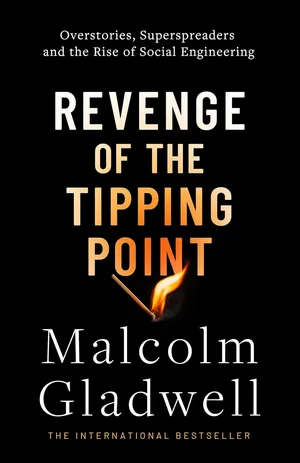
I've been a big fan of Malcolm Gladwell for a long time and I've read all of his books. I've recommended one here a long time ago titled "Outliers: The Story of Success" as well as his podcast called "Revisionist History".
He has an incredible ability to make history facts interesting as well as connecting the dots and showing you things you never thought were related.
I don't want any spoilers, so let's go for the book's premise.
Book premise
The book touches a lot of topics like cheetahs, Ivy League sports, Los Angeles in the 1990s, teen suicide, COVID-19, and the opioid crisis, all of them to demonstrate the "rule of thirds" concept. You have to read the book to understand where these things connect. You can search for it online and you will get the concept related with photography, business and fitness to name a few, but not a lot related to what he talks about in the book.
It's a page turner for sure and I don't want to go into much more detail since it's not my place to explain this.
The author
It's possible that you don't know him but you know the "10,000-Hour Rule," something that he talks about a lot in the "Outliers: The Story of Success". It's something that has now become part of life and everyone indicates that as one of the true things to success in life. I can't say I agree but who am I to say otherwise. Read the book and make your own conclusions.
He's also very charismatic and has a lot of talks online if you want to learn a bit more. One of my favorites and it's a bit old is this one.
You can watch it even if you're not thinking about reading the book.
Why did I like it?
The book jumps a lot from use-cases to use-cases, showing how certain facts interact with the "rule of thirds". I enjoyed the examples a lot and he presented them in a way that by itself only the examples would make quite an entertaining and educational book. But it went further than that and took some conclusions from those facts. It's interesting to understand how these things happen and why that happens, at least in his perspective. It's one more datapoint in your mind for when you have to make decisions or when you see the pattern happening. Knowledge is great this way because nothing is useless and that's the main reason I liked this book a lot.
There are, however, people who didn't like it, like everything in life. I saw this article where they debate that "...might be a page turner, but it probably isn't science...". While I agree with the first part, I can't say for the second. Like every book in this genre it's good to read it, absorb the concepts and then make your own conclusions and adjust to your life what makes sense. There isn't a universal truth to things as well as there's no scientific angle to this book. It's not meant to be scientific, it's meant to educate and to entertain in equal parts and I can say it did both in my case.
Finally, on the topic of other opinions, this book has definitely a "formula" like all his other books. There's a reddit post of people complaining about this, but I don't think there's anything wrong with formulas. I will write soon about Dan Brown's new book and the formula is there as well and the book was immensely enjoyable, but take this in consideration in case you don't like it.
I don't re-read books a lot, but I think this will be one of the books I'll revisit in a few years for sure.
Where you can find it
Want more? Check my other book suggestions.
I have no affiliation with this brand or person (people), and the views here are my own. I didn't have any bad experiences, but if you do, please know that this is a recommendation, and you're always free to make decisions by yourself before buying something.
No comments yet
Be the first to share your thoughts on this article!